Table of Contents
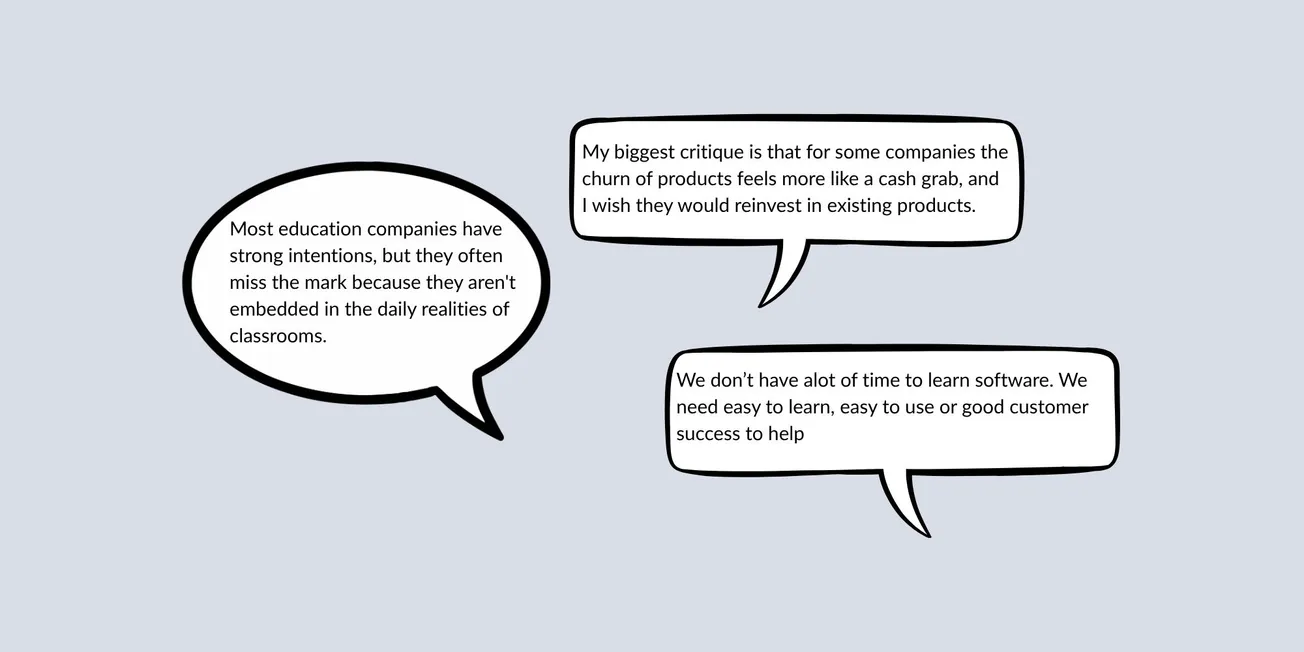
When we asked a few hundred educators what they really think, we learned one thing above all else: What educators have to say always matters. Here's what a few of them had to say, which we think are worth repeating until the industry really shows that it's listening.
💡
Companies mean well, but the disconnect is real...
From my experience working daily in schools, I believe many education companies do strive to understand the needs of students, teachers, and school leaders, but there is often a gap between their intentions and the realities of the classroom. What they get right: Many companies develop high-quality content and tools grounded in research. They offer solutions that can be powerful when implemented thoughtfully and with proper training. Some providers show willingness to innovate and incorporate educator feedback over time. Where they fall short: Too often, products feel designed more for data collection or compliance rather than for practical use by teachers in busy classrooms. There is a disconnect between the complexity of their systems and the limited time teachers have to learn and integrate them effectively. Many solutions lack true flexibility to meet diverse student needs and classroom contexts. Professional development and ongoing support are frequently insufficient or not tailored to real-world challenges. Companies sometimes overlook the emotional and social realities teachers face—burnout, trauma, and equity issues—focusing too narrowly on academic metrics. What I wish education companies really understood: Teachers need tools that save time and reduce workload, not add layers of complexity. Solutions should be designed with educators from the start, not just tested on them after development. Emotional support and well-being for educators and students must be integrated into educational products, not treated as an afterthought. Cultural relevance and inclusivity are critical for student engagement and success. Ongoing, practical professional learning tied directly to classroom use is essential for lasting impact. Ultimately, education companies must listen more deeply to those working in classrooms every day and prioritize usability, relevance, and support to truly make a difference.
From my experience working daily in schools, I believe many education companies do strive to understand the needs of students, teachers, and school leaders, but there is often a gap between their intentions and the realities of the classroom. What they get right: Many companies develop high-quality content and tools grounded in research. They offer solutions that can be powerful when implemented thoughtfully and with proper training. Some providers show willingness to innovate and incorporate educator feedback over time. Where they fall short: Too often, products feel designed more for data collection or compliance rather than for practical use by teachers in busy classrooms. There is a disconnect between the complexity of their systems and the limited time teachers have to learn and integrate them effectively. Many solutions lack true flexibility to meet diverse student needs and classroom contexts. Professional development and ongoing support are frequently insufficient or not tailored to real-world challenges. Companies sometimes overlook the emotional and social realities teachers face—burnout, trauma, and equity issues—focusing too narrowly on academic metrics. What I wish education companies really understood: Teachers need tools that save time and reduce workload, not add layers of complexity. Solutions should be designed with educators from the start, not just tested on them after development. Emotional support and well-being for educators and students must be integrated into educational products, not treated as an afterthought. Cultural relevance and inclusivity are critical for student engagement and success. Ongoing, practical professional learning tied directly to classroom use is essential for lasting impact. Ultimately, education companies must listen more deeply to those working in classrooms every day and prioritize usability, relevance, and support to truly make a difference.
💡
Out of touch
I haven’t been satisfied by any curriculum. They are just out of touch with the type of students we have in our classrooms.
I haven’t been satisfied by any curriculum. They are just out of touch with the type of students we have in our classrooms.
💡
Are you even listening?
From my perspective as someone who has been in the classroom every day for over 20 years, I can say this: most curriculum companies have strong pedagogical intentions behind their programs. I can see and appreciate the research and theory that went into their development. But in practice, many of these programs simply don’t reflect the realities of today’s classrooms. Curriculum is often overwhelming. It tries to cover too much, too quickly, and teachers are left feeling like they’re constantly behind or skipping through important content just to “get through it.” The messaging around implementation is inconsistent-sometimes we’re told to go fast because it spirals, other times we’re told to go slow to build deep understanding. This leaves teachers confused, and kids move on with gaps in learning. Where these companies often fall short is in truly understanding the day-to-day challenges teachers face: Classrooms today include large numbers of struggling readers, students with foundational math gaps, behavior challenges, and engagement issues. Teachers are pulled in a million directions, trying to differentiate for every learner while managing planning, prep, assessments, and behavior. MTSS is a great goal—but strong Tier 1 instruction has to come first, and too often it’s buried under unrealistic expectations and overloaded curricula. What curriculum companies need to do better: Pilot your programs in real, diverse classrooms and observe closely. Watch what teachers actually face—how they navigate behaviors, engagement issues, academic gaps, and time constraints. Prioritize teacher usability. Curriculum platforms should be user-friendly, with minimal clicking and a clear, easy-to-follow scope and sequence. Manuals with too many options and pathways are overwhelming. Keep it simple. Teachers need less—less fluff, fewer extras, and more clarity. We’re juggling multiple subjects (especially in elementary), so materials should be integrated where possible and not feel like they’re all coming from different planets. Integrate SEL and real-world connections. Today’s students need more than just content. SEL isn’t extra—it’s essential. Build it into your curriculum in meaningful, not superficial, ways. Support matters. When teachers are properly trained, supported, and given time to plan and prep, implementation improves—and so does student learning. But without that, even the best curriculum fails. We also need opportunities to use AI and other types of technology to help reduce our workload, streamline planning, and better meet the needs of diverse learners. These tools shouldn’t be seen as extras—they should be integrated into the curriculum and supported through training, so teachers can actually use them effectively and responsibly. Lastly, we need less testing, and more teaching so kids can learn. What I wish these companies truly understood is this: teachers are not the barrier—they’re the bridge. But we’re exhausted, and we need less to do more. If companies want to make an impact, they need to start by truly listening to the people in the classroom.
From my perspective as someone who has been in the classroom every day for over 20 years, I can say this: most curriculum companies have strong pedagogical intentions behind their programs. I can see and appreciate the research and theory that went into their development. But in practice, many of these programs simply don’t reflect the realities of today’s classrooms. Curriculum is often overwhelming. It tries to cover too much, too quickly, and teachers are left feeling like they’re constantly behind or skipping through important content just to “get through it.” The messaging around implementation is inconsistent-sometimes we’re told to go fast because it spirals, other times we’re told to go slow to build deep understanding. This leaves teachers confused, and kids move on with gaps in learning. Where these companies often fall short is in truly understanding the day-to-day challenges teachers face: Classrooms today include large numbers of struggling readers, students with foundational math gaps, behavior challenges, and engagement issues. Teachers are pulled in a million directions, trying to differentiate for every learner while managing planning, prep, assessments, and behavior. MTSS is a great goal—but strong Tier 1 instruction has to come first, and too often it’s buried under unrealistic expectations and overloaded curricula. What curriculum companies need to do better: Pilot your programs in real, diverse classrooms and observe closely. Watch what teachers actually face—how they navigate behaviors, engagement issues, academic gaps, and time constraints. Prioritize teacher usability. Curriculum platforms should be user-friendly, with minimal clicking and a clear, easy-to-follow scope and sequence. Manuals with too many options and pathways are overwhelming. Keep it simple. Teachers need less—less fluff, fewer extras, and more clarity. We’re juggling multiple subjects (especially in elementary), so materials should be integrated where possible and not feel like they’re all coming from different planets. Integrate SEL and real-world connections. Today’s students need more than just content. SEL isn’t extra—it’s essential. Build it into your curriculum in meaningful, not superficial, ways. Support matters. When teachers are properly trained, supported, and given time to plan and prep, implementation improves—and so does student learning. But without that, even the best curriculum fails. We also need opportunities to use AI and other types of technology to help reduce our workload, streamline planning, and better meet the needs of diverse learners. These tools shouldn’t be seen as extras—they should be integrated into the curriculum and supported through training, so teachers can actually use them effectively and responsibly. Lastly, we need less testing, and more teaching so kids can learn. What I wish these companies truly understood is this: teachers are not the barrier—they’re the bridge. But we’re exhausted, and we need less to do more. If companies want to make an impact, they need to start by truly listening to the people in the classroom.
💡
Keep it simple
I do not think that many companies understand what teachers and students need. Often, many of the companies that I’ve worked with overcomplicate dashboards and tasks. Teachers are overwhelmed with the amount of applications and sites used daily, the simpler the better.
I do not think that many companies understand what teachers and students need. Often, many of the companies that I’ve worked with overcomplicate dashboards and tasks. Teachers are overwhelmed with the amount of applications and sites used daily, the simpler the better.
💡
Good intentions, but let's get real
I think they do a great job TRYING. We have all these amazing curriculums that we pilot that have nothing but good intentions...but we go to implement and it just doesnt work! Sometimes, the lessons are too long. Or developmentally, it is inapproproate for the grade level. Sometimes, its boring and the kids HATE it (for example, heggerty is fantastic for learning reading but so many kids hate the verbalizing of it day in and day out). Even SEL curriculum... there is intention for it to change kids' lives but its boring and either too babyish or too advanced and it feels inappropriate to continue to teach. I wish that the companies themselves would pilot this information, rather than making teachers do it. Can they come in and teach it and make observations before it even gets to the piloting level for the education system (and maybe they do!). I think continuing to combine SEL/reading/writing like HMH is doing is a great start, but I think we just need to ensure that we aren't missing out on important topics in any area with trying to kill two birds with one stone. Kids are so jam packed with STUFF. I honestly wish they had more time to create art and play and socialize. I think many of our behavioral needs would decrease if this were the case. How can be make a case for play-based activities and is this even possible? I just notice that teachers and students are getting more and more and MORE and along those lines, behavioral and social/emotional needs are sky rocketing. We need to let kids be kids at a certain level.
I think they do a great job TRYING. We have all these amazing curriculums that we pilot that have nothing but good intentions...but we go to implement and it just doesnt work! Sometimes, the lessons are too long. Or developmentally, it is inapproproate for the grade level. Sometimes, its boring and the kids HATE it (for example, heggerty is fantastic for learning reading but so many kids hate the verbalizing of it day in and day out). Even SEL curriculum... there is intention for it to change kids' lives but its boring and either too babyish or too advanced and it feels inappropriate to continue to teach. I wish that the companies themselves would pilot this information, rather than making teachers do it. Can they come in and teach it and make observations before it even gets to the piloting level for the education system (and maybe they do!). I think continuing to combine SEL/reading/writing like HMH is doing is a great start, but I think we just need to ensure that we aren't missing out on important topics in any area with trying to kill two birds with one stone. Kids are so jam packed with STUFF. I honestly wish they had more time to create art and play and socialize. I think many of our behavioral needs would decrease if this were the case. How can be make a case for play-based activities and is this even possible? I just notice that teachers and students are getting more and more and MORE and along those lines, behavioral and social/emotional needs are sky rocketing. We need to let kids be kids at a certain level.
💡
Educators are an important part - but not the only
I wish education companies really understood how schools and educators are only part of the equation. The other part is the home environment and parents. That's where kids learn the value of education and its importance in your life.
I wish education companies really understood how schools and educators are only part of the equation. The other part is the home environment and parents. That's where kids learn the value of education and its importance in your life.
When it comes to edtech strategy and planning, if the educator's voice isn't in the room, then nothing else matters. Here's hoping the industry is listening.