

Table of Contents
In this article, I share recent developments in the high-tech and incredibly competitive Chinese AI learning tablet market. Multiple players are investing billions of dollars into improving their solutions, but navigating content partnerships requires nuance, care, and expertise.
From the Field
Recently, I picked up a new pair of real-time translating headphones while visiting a leading AI learning/tablet company HQ based in Hefei, China. Then, a product manager handed me a learning tablet and told me to write a short English essay. I wrote a few sentences, maybe the kind a Chinese middle schooler might write when they are learning English. I deliberately included a few common errors. Within seconds, the device had underlined every mistake, suggested corrections, and scored the essay across eight dimensions: grammar, vocabulary, logic, style, cohesion, structure, spelling, and creativity. It even caught grammar issues that I had NOT deliberately made!

After, the tablet offered to have a conversation with me, in English, out loud, adjusting its speed and complexity to my level. It was powered by one of China’s most advanced AI engines. The tablet retails for 11,699 yuan (around $1600) as a one-time fee with no additional monthly or annual subscriptions built into the business model.
A week earlier, I had dinner with the CEO of another tablet company in Shanghai, followed by a visit to their product showroom. Different company, different approach, same underlying belief that AI powered digital solutions are an important part of the future of education in China.
And at the headquarters of one of the largest education companies in China, I walked through a campus-sized complex where thousands of engineers are building their version of AI-powered learning tools. Today, they are evolving from an after-school tutoring organization to a hardware and AI company.
Three companies. Three visits. Three major players all pursuing a similar strategy. My conclusion is the learning tablet is not a gadget or a trend, it is central to learning going forward.
Market Intel: The Numbers Behind the Tablet Boom
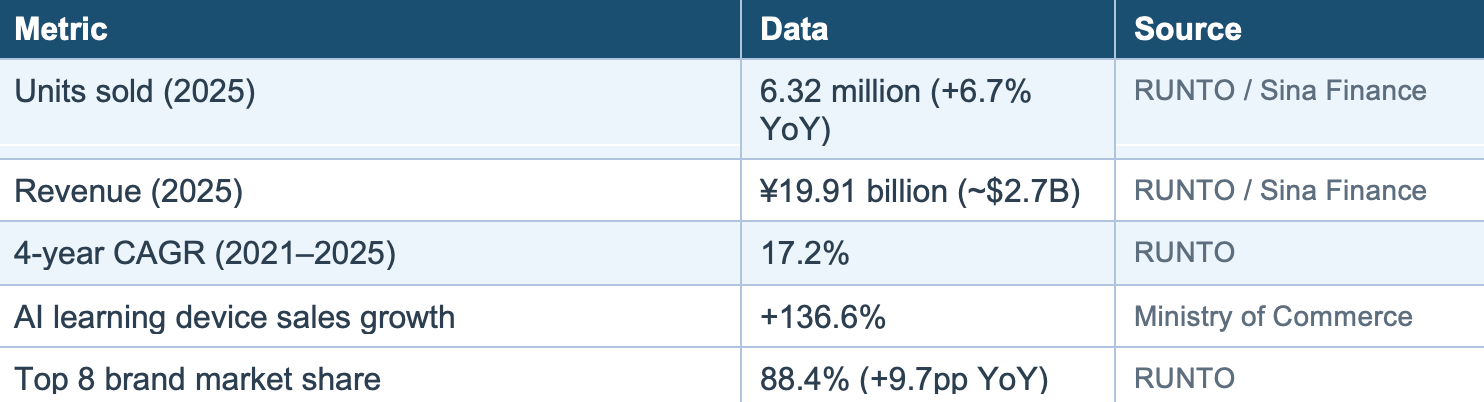
In 2025, Chinese families bought 6.32 million AI learning tablets - a four-year surge that has seen annual sales nearly double since 2021 (3.34 million units). Total revenue hit 19.91 billion yuan (approximately USD $2.7 billion). The broader educational device market is expected to grow significantly over the next few years and expand beyond the Chinese borders.
When government policies around learning English changed in 2021, much of the Chinese after-school English tutoring center market changed rapidly. Demand from families didn’t disappear; it migrated. Families that once spent thousands of yuan per month on learning centers and other programs started buying AI-powered tablets that promised personalized instruction for a one-time cost. A fixed price device replaced a tutor/center who charges per session/month/hour. The math is compelling.
What's Actually On These Tablets
These learning tablets are not single-purpose English learning devices. They are full-spectrum education platforms. A typical premium tablet in 2026 covers:
Chinese language and literature: essay grading across eight dimensions, classical text analysis, reading comprehension training
- Mathematics: interactive problem solving with step-by-step AI coaching, handwritten equation recognition, geometry visualization tools
- English: AI-powered speaking practice calibrated to provincial exam standards, real-time essay correction, graded reading libraries with hundreds of licensed titles
- Science: physics, biology, and chemistry modules with simulated experiments
- Programming and STEM: coding tutorials, logic training, aerospace education kits
- Arts and enrichment: music theory, history and culture content, general knowledge encyclopedias
High end flagship devices carry over hundreds of hours of course content and access to a question bank of 1.6 billion problems. Other tablets are powered by multiple AI engines that can simulate Cambridge oral exam environments for English practice. Even entry-level tablets include oral English modules calibrated to different provincial exam systems.
The companies building these tablets are actively including authentic English content — graded readers, songs, videos, phonics programs, leveled libraries, original stories — to differentiate their platforms from the competition. They need strong brands, excellent content, and business terms that match their models.
Online sales channels account for 67.7% of all learning tablet sales. But traditional e-commerce (ala Amazon-style in the US) is being overtaken by live-streaming and live-promotion platforms, which now represent 43% of total online sales and growing fast. I’ve written about the power of these channels and how central they are to the promotion of all learning materials across China.
Tablet companies run multi-hour live broadcasts demonstrating AI features in real time to audiences of tens of thousands of parents. These broadcasts are highly sophisticated, require advertising budgets to attract viewers, and are staffed by very charismatic influencers who can authentically connect with their viewers.
The Price Map
The learning tablet market is consolidating around three tiers. Within each tier, there are marketing and age tiers targeting different ages of children, geographic parts of China, or specialized learning priorities. There is no one-size-fits-all tablet solution in China today:
- Entry level (under ¥2,000 / ~$275): Basic features, limited AI. This tier faces constant price pressure on technology, capabilities, and content. Entry level devices account for about 42% of the market in terms of unit volume.
- Mid-range (¥2,000–¥2,999 / $275–$410): Mid-range devices dominate the landscape. Each of the big players has multiple versions with new editions coming out several times each calendar year. Mid-range tablets command 45.9% of the market share because they balance good enough AI, content, and technology in a value-driven manner.
- Premium (¥5,000+ / $690+): Maintaining an 11.5% share, devices in this range contain the best AI engines, largest content libraries, premium displays and prominent marketing. Launch events are newsworthy in an Apple-style manner.
The top eight brands now control 88.4% of the market and is up 9.7 percentage points year-over-year. Consolidation is accelerating in this part of the market.
What This Means for Publishers
If you’re a publisher with English language content (graded readers, phonics, leveled fiction and nonfiction, assessment tools, or original stories) the learning tablet market represents something attractive: a distribution channel where your content is embedded directly into the device families already use every day. You don’t need to compete for shelf space in a bookstore, fight for downloads in an app store, or negotiate with a traditional distributor.
We are actively working with or in discussions with all of the top tablet companies in China and their needs, priorities, and differences are all over the board. Some are dedicated to creating their own content, assessment, and materials in house. Others want large consumer brands of content to help drive marketing to sell devices. Others are looking for the best and most proven educational material that matches their curriculum philosophy. Some tablet companies refresh their English content yearly, others only every few years based on their sales and brand priorities.
But, working with tablet companies requires a new understanding and flexibility from publishers. Tablet companies need to control their environment, so they have very strict technology hosting requirements. Also, their business model requires a large amount of content, but with a fixed budget, which doesn’t work for some publishers. Original news articles, books, and stories are still highly valued in this channel.
Wingspan is the regular Chinese and Global ELL newsletter published by Andy Shafran, founder of Blue Heron Global. Andy is the go-to expert for global publishers entering China’s children’s ELL market.
Sources
- RUNTO (LuoTu Technology) via Sina Finance: 2025 learning tablet market data (units, revenue, channel share, brand concentration, pricing tiers, 2026 forecast). https://finance.sina.com.cn/tech/roll/2026-02-26/doc-inhpaxnu4532539.shtml
- Ministry of Commerce: AI learning device sales +136.6%. https://english.www.gov.cn/archive/statistics/202407/19/content_WS669a3f76c6d0868f4e8e9452.html