Table of Contents
Through a national survey of classroom teachers, directors, and administrators, we wanted to find out what educators think about the products and services they use, and how they perceive the companies that deliver them. Let's just say, we have work to do.
The industry is currently preoccupied with AI trends in education, rightly so. From utilization to perception, AI is taking center stage in how companies develop and position products, while educators are working through rapidly changing frameworks and expectations. But, rather than asking about AI, we asked about how educators perceive the industry's capacity to deliver in a variety of segments, including enterprise software, assessment, and curriculum. We wanted to know:
- Do educators feel like the industry understands them?
- Are providers meeting the actual needs of educators?
- Can the industry be trusted to deliver?
We started by looking for themes that emerged from the open ended responses to our survey - where we invited educators to speak their mind, in their own words, so that the Educator Voice came through loud and clear. In keeping with the times, we ran the data through an AI engine to surface themes. We've also summarized key takeaways from our first-hand review and analysis of the data. Here's what we found.
Education Advisor Survey — Theme Analysis
Qualitative analysis of open-ended responses from K–12 education advisors on perceptions of education providers
Theme frequency — % of responses mentioning each theme
Explore each theme — click to expand quotes
Educators are frustrated by providers
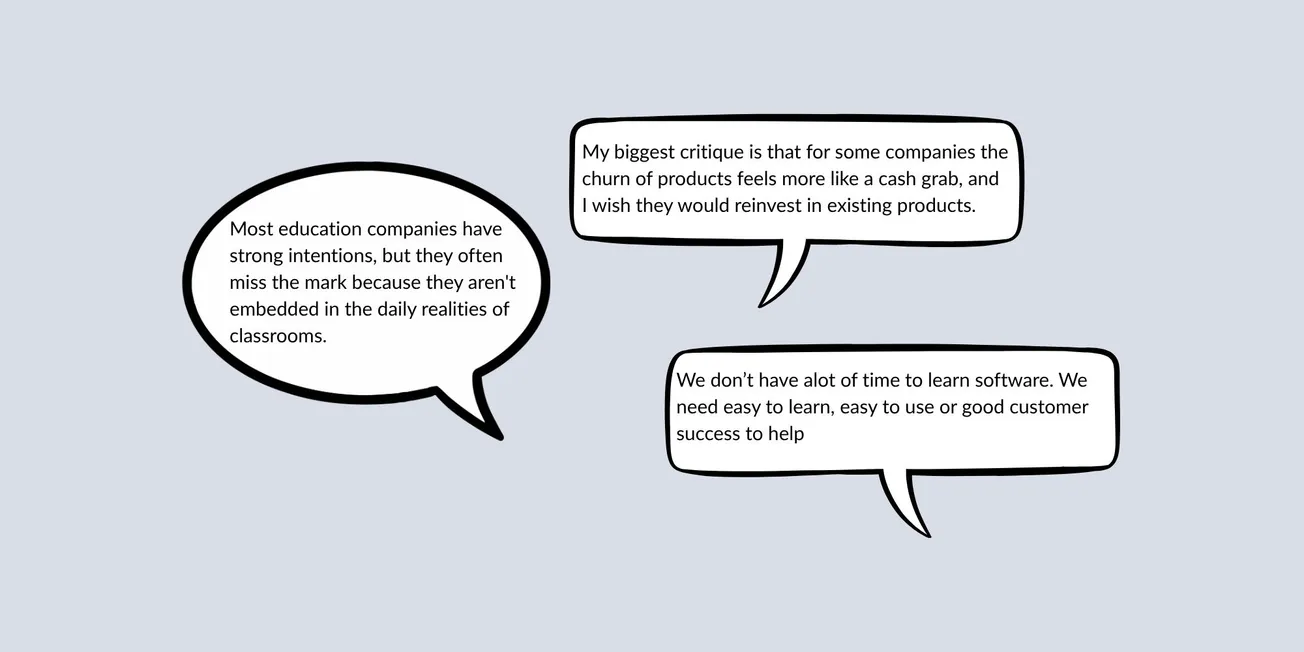
The top theme, by a meaningful, is the perception of a disconnect from classroom reality Educators feel that companies design in a vacuum, testing products in ideal conditions that bear little resemblance to real classrooms with behavioral challenges, time pressure, and wildly diverse student needs. The most common ask among educators is that that companies spend time in real schools before building products, updating features, or touting their transformative powers.
This perception of a disconnect becomes real when educators think about usability and time burden, which emerged as another critical theme - one that feels largely critical of how companies fail to accomplish what they set out to do. Teachers don't have time to wade through complex platforms. Tools that require significant training or navigation get abandoned. The refrain was consistent: "Give me simple, fast, and ready to use, or I'm not going to use it."
Another important theme? Companies are working towards the mean, which means that they are not effectively helping teachers serve students at the margins. Students IEPs, ELL students, students in poverty, and advanced learners all sit outside the mainstream; educators perceive that companies are, for the most part, focused on scaling their reach by delivering a one-size-fits-all model, which is a persistent frustration. This is one area where AI shows promise, or at the very least, where AI companies are touting the promise of a breakthrough in truly personalized learning. Educators, however, are likely to remain skeptical.
The trust deficit that many educators feel is real, particularly among classroom teachers. Companies sell to administrators and superintendents, not the teachers who actually use the products daily, which brings the risk of misalignment between what gets purchased and what actually works.
It's not all bad, for some
Across four product categories, including assessment, curriculum, SEL, and Student Information Systems, a clear pattern emerges: educators reserve their highest praise for tools that save time, adapt to student needs, and deliver actionable data without adding complexity.
Remember, this research centered on perception, and is not a scientific evaluation of any company's individual performance or efficacy. Many companies cited in this research do, in fact, have valid and reliable research supporting their impact. With that said, however, perceptions matter.
In the category of assessment providers, IXL Learning and Amplify/iReady have earned the respect of educators, with teachers citing measurable student growth and useful diagnostic reporting. In the curriculum space, a few companies that earned praise include Newsela, BrainPop, and Lexia Learning, which educators felt were able to deliver on engagement, differentiation, and relevance to real classroom instruction.
Interestingly, SEL remains a category of service providers met with some of highest levels of skepticism. No single provider breaking 40% in terms of positive perception, among respondents who were familiar with the brands included in our survey. Second Step and Character Strong are largely viewed as well intentioned but not altogether consistent in their effectiveness. It's worth noting that this is a perception survey of
Student Information Systems attract the most frustration of any category. PowerSchool dominates by sheer ubiquity, but satisfaction is mixed across the board, with teachers describing systems that are clunky, outdated, or difficult for parents to use.
Taken together, the providers that earn genuine respect share a common trait: they were clearly built with input from educators, and it shows.